
The recipients of the Pierre du Bois Prize in 2026, awarded annually for the best doctoral thesis in International History and Politics defended at the Geneva Graduate Institute, are, ex aequo, Dr Michele Zampa and Dr Atwa R. H. Jaber.
Dr Michele Zampa
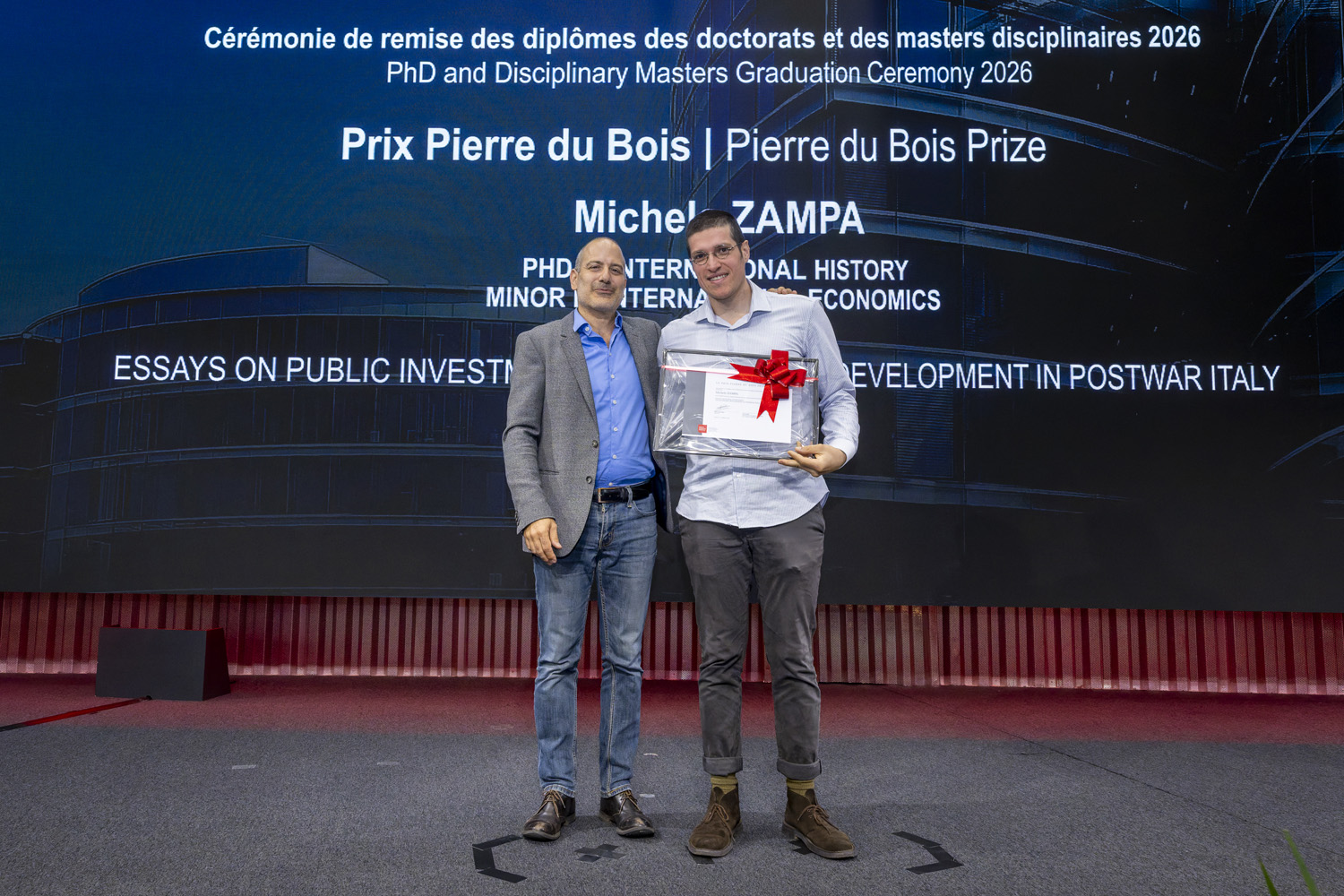
Michele received the Pierre du Bois Prize for his thesis Essays on Public Investment and Economic Development in Postwar Italy. The dissertation asks a question that remains central to contemporary economic policy: when – and under what conditions – can public investment successfully promote regional development? Focusing on postwar Italy, it examines how state-led investment shaped firms, industries, and local economies. To do so, Michele assembled new evidence from municipal censuses, administrative archives, firm balance sheets, and reconstructed the evolution of the entire Italian road network for the postwar period using a custom algorithm.
The thesis is composed of three studies. The first two examine the Cassa per il Mezzogiorno, a public agency operating between 1950 and 1984 with the task of addressing the longstanding economic divide between Northern and Southern Italy. The first assesses the Cassa’s two main forms of intervention: support for private industry and investment in public infrastructure. It finds that industrial support generated sustained local industrial growth but could also slow the development of public infrastructure, while infrastructure investment was most effective when projects were coordinated across municipalities and pursued clear, measurable goals. The second study narrows the focus to the Cassa’s subsidised-credit programme, following Southern Italian firms over 15 years. Firms that received support expanded and became more efficient, but strict lending rules prevented many otherwise viable businesses from benefiting, limiting the programme’s wider regional impact. The third study turns to Italy’s expanding motorway network. It shows that better connections reshaped local economies, reduced industrial specialisation, and integrated municipalities more firmly into wider labour markets. Taken together, the studies show that public investment can transform regional economies, but its success depends on how programmes are designed, coordinated, and targeted – lessons that remain highly relevant to industrial and regional policy today.
Michele is currently a Visiting Fellow in the Department of Geography and Environment at the London School of Economics and Political Science, funded by an SNSF Postdoc.Mobility grant. There, he is working on developing a research agenda based on the historical road network that he reconstructed during his thesis in order to explore the long run effect of transport infrastructure’s improvements on the economic development of local economies.
Michele is deeply grateful to his PhD supervisors, Professors Rui Esteves and Nathan Sussman, for their unwavering guidance and support.
Links: Personal Website, LinkedIn, and IHEID profiles.
Dr Atwa R. H. Jaber
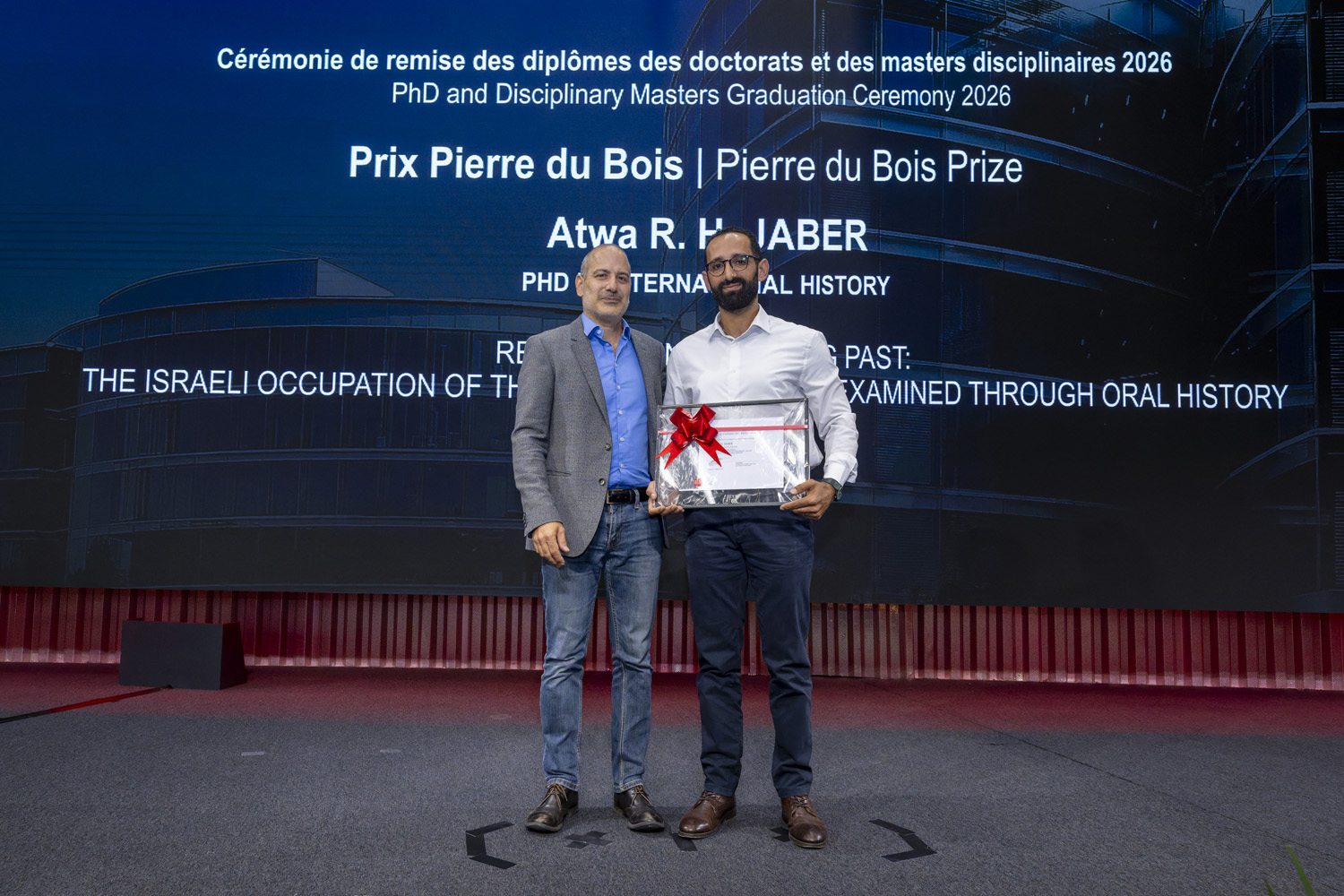
Atwa received the Pierre du Bois Prize for his thesis titled Remembering a Fading Past: The Israeli Occupation of the Jordan Valley Re-examined Through Oral History. His dissertation studies the 1967 Israeli occupation of the Jordan Valley through Palestinian oral histories, foregrounding the lived experiences of those who endured the 1976 War, forced displacement, and their long aftermath.
Bringing together oral testimonies, extensive archival research, and overlooked visual materials, Atwa’s work reconstructs Palestinian life in the Jordan Valley before the occupation and traces the dynamics and consequences of displacement across both banks of the Jordan River. Writing a social history from below, Atwa’s research recovers and centers marginalized narratives and local microhistories, which demonstrate how the Israeli occupation transformed the Jordan Valley from a space characterized by vibrant social life, productive agriculture, and vital mobility into a militarized frontier marked by depopulation, dispossession, and territorial fragmentation. It also documents the strategies through which Palestinian communities were expelled, prevented from returning, and subjected to spatial erasure. At the same time, it illuminates diverse forms of Palestinian response and resistance, including clandestine return, the revival of agrarian life in exile, and steadfastness in the face of ongoing settler-colonial encroachment. In centering everyday experiences of displacement, loss, return, and resistance, Atwa’s thesis reframes the Jordan Valley as a critical site in the contemporary history of the Palestinians. More broadly, his study contributes to debates on the social histories of displaced communities, on settler colonialism, and on the geographies of violence and resistance in post-1967 Palestine and the larger region.
Atwa is currently a Postdoctoral Researcher at the University of Basel with the SNSF project Futures Interrupted: social pluralism and political projects beyond coloniality and the nation-state, where he develops his methodology to study the social histories of Palestinian refugees throughout the Arab world in the three decades following the Nakba. Starting January 2027, Atwa will begin a new project as a Visiting Fellow in the Faculty of History at the University of Cambridge, funded by the SNSF Postdoc.Mobility grant, where he will explore the lived experiences of Palestinian refugees between moments of socio-political rupture, examining the histories of six refugee camps across Palestine, Jordan, and Lebanon.
Atwa is grateful for the generous support and mentorship of his PhD supervisors, Professors Mohamed Mahmoud Ould Mohamedou†, Nicole Bourbonnais, and Riccardo Bocco.
Links: ORCID, SNSF, and IHEID profiles.
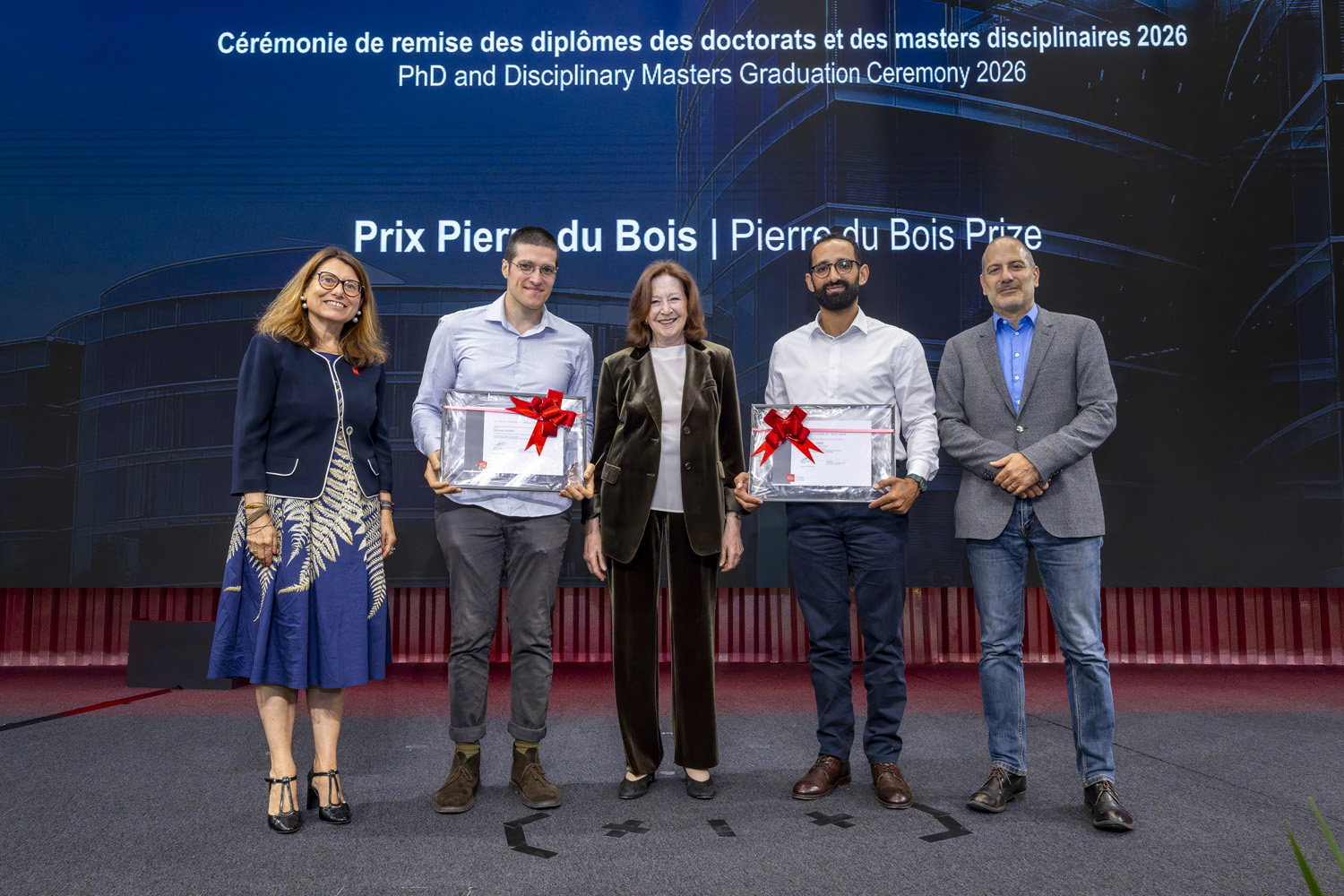
Watch the Pierre du Bois Prize Ceremony in the video below: